The Problem
Popular events on Kide.app sell out in seconds. Users need to be online exactly when sales open, navigate the UI quickly, and hope their connection holds. Missing a drop means waiting for resale or missing the event entirely.
I wanted a system that could monitor events continuously, notify me when sales open, and automatically reserve tickets to my cart — all running on a server so browser crashes or network hiccups wouldn't kill the reservation.
The Solution
Tärppi is a full-stack event monitor built with React 19, TypeScript, Express 5, and PostgreSQL. The frontend runs on Vercel, the backend runs on Railway, and an optional FastAPI reranker scores events by demand.
The core workflow: users paste a Kide.app event URL, the system validates it, tracks the event, and schedules a reservation job. When sales open, the backend reserves the selected ticket variant to the user's cart and sends a Telegram alert. Payment still happens on Kide.app — Tärppi just handles the speed-critical reservation step.
The system is live at tarppi.site and has been reserving tickets successfully since launch.
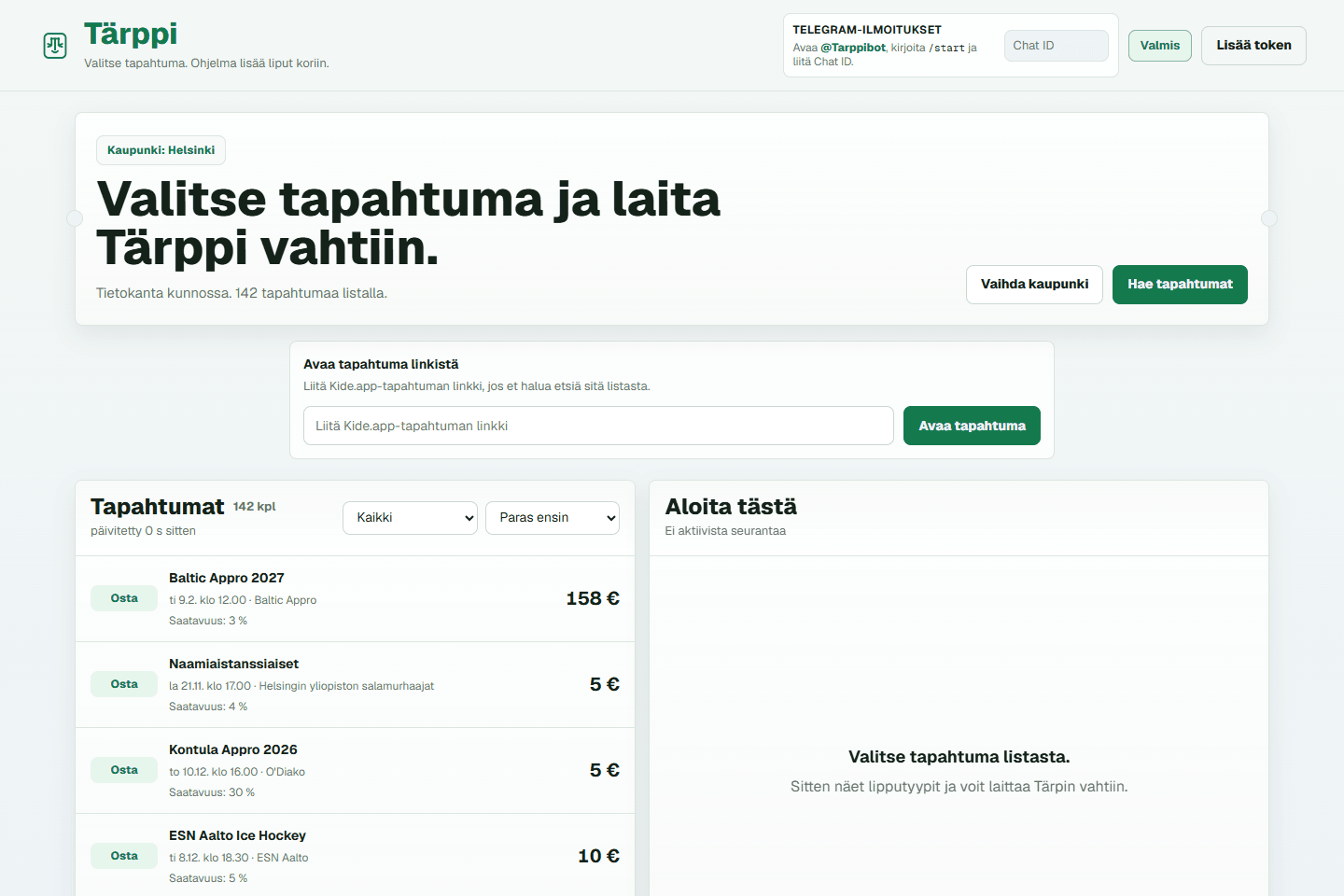
Architecture
The frontend is a compact operations console. It shows backend health, token status, active scans, and reservation state in one view. Users can paste event URLs, browse city scans, configure their Kide.app token, and start reservation jobs without navigating between pages.
The backend polls Kide.app for event updates, persists jobs in PostgreSQL for restart recovery, and uses an encrypted session store for user tokens. Reservation jobs run server-side in isolated workers, so closing the browser doesn't cancel the job.
The optional AI reranker uses FastAPI and scikit-learn to score events based on historical demand patterns. If it's offline, the system falls back to heuristic scoring.
Technical Decisions
Server-side jobs were non-negotiable. Browser-based reservation scripts fail when the tab closes, the laptop sleeps, or the network drops. Railway provides persistent compute with auto-restart, so jobs survive deployments.
Token storage needed to balance security and usability. I encrypt tokens with a rotation-capable key, store them in PostgreSQL, and clear them on logout. Users re-authenticate by pasting a fresh token from their Kide.app session.
Telegram notifications provide instant feedback without requiring users to check the app. When a ticket lands in the cart, the bot sends the event name, variant, and a direct link.
Kide.app Integration
Kide.app has no public API, so Tärppi works by observing the same HTTP requests the website makes. The system respects rate limits, only fetches events users have explicitly tracked, and never attempts payment — that step stays manual.
Event URLs are validated before tracking. The system extracts the event ID, fetches metadata, checks that sales haven't ended, and stores the event details. Invalid or expired links are rejected immediately.
Reservation timing matters. The system schedules the job slightly before the official sale time, waits for the exact moment, then sends the reservation request. If the sale time shifts, the job adapts.
Challenges
Timing precision was difficult. Clocks drift between the client, Railway, and Kide.app. I poll event metadata for updated sale times and use server timestamps to avoid client clock skew.
Error handling needed to be specific. A failed reservation could mean the event sold out, the token expired, the variant is unavailable, or the network timed out. The system logs the exact failure reason and surfaces it in the UI.
Concurrent users required job isolation. Each reservation runs in its own worker with its own token and cart state. Shared state would let one user's cart leak into another's.
Current Status
Tärppi is live at tarppi.site. The backend has successfully reserved tickets for multiple events, the Telegram bot delivers alerts reliably, and the UI handles backend outages gracefully.
The public repository at github.com/Murtsi/Kidehiiri-public contains product documentation and links. The private source includes the full implementation, deployment configs, and tests.
Future work includes better mobile UX for small screens, historical success rate tracking, and support for more ticket platforms.
Stack
Frontend: React 19, TypeScript, Vite, Tailwind CSS, deployed on Vercel.
Backend: Express 5, PostgreSQL, Railway deployment with Nixpacks.
AI Reranker (optional): FastAPI, scikit-learn, Railway.
Notifications: Telegram Bot API.
Testing: Playwright for end-to-end flows, Vitest for unit tests.